

How PCBCool Supports Hardware Teams Through a Global Manufacturing Network
Hardware companies rarely have the same manufacturing priorities throughout a product’s lifecycle. An early prototype may depend on fast engineering feedback and flexible assembly, while repeat production places more weight on component availability, stable capacity, cost control and delivery to the target market.
These needs can also vary by region. A production route that works well for a cost-sensitive order may not be the best option for a product that requires shorter delivery distances to North America. Complex PCB fabrication, electronics assembly and final product integration may each be better suited to different locations.
PCBCool, the digital brand of PS Electronics, supports international hardware companies through a manufacturing network that includes China, Malaysia and Mexico. The network covers PCB fabrication, component sourcing, PCB assembly, testing and box-build manufacturing, allowing each project to be matched with a production route based on its technical and commercial requirements.
Why a Multi-Region Manufacturing Network Matters
Relying on a single factory can limit the choices available to a hardware company. Production capacity may be sufficient, but the location may create longer transportation routes. A factory may offer competitive assembly costs but lack access to the materials or PCB technologies required by a more complex design.
A multi-region network provides more room to balance these factors.
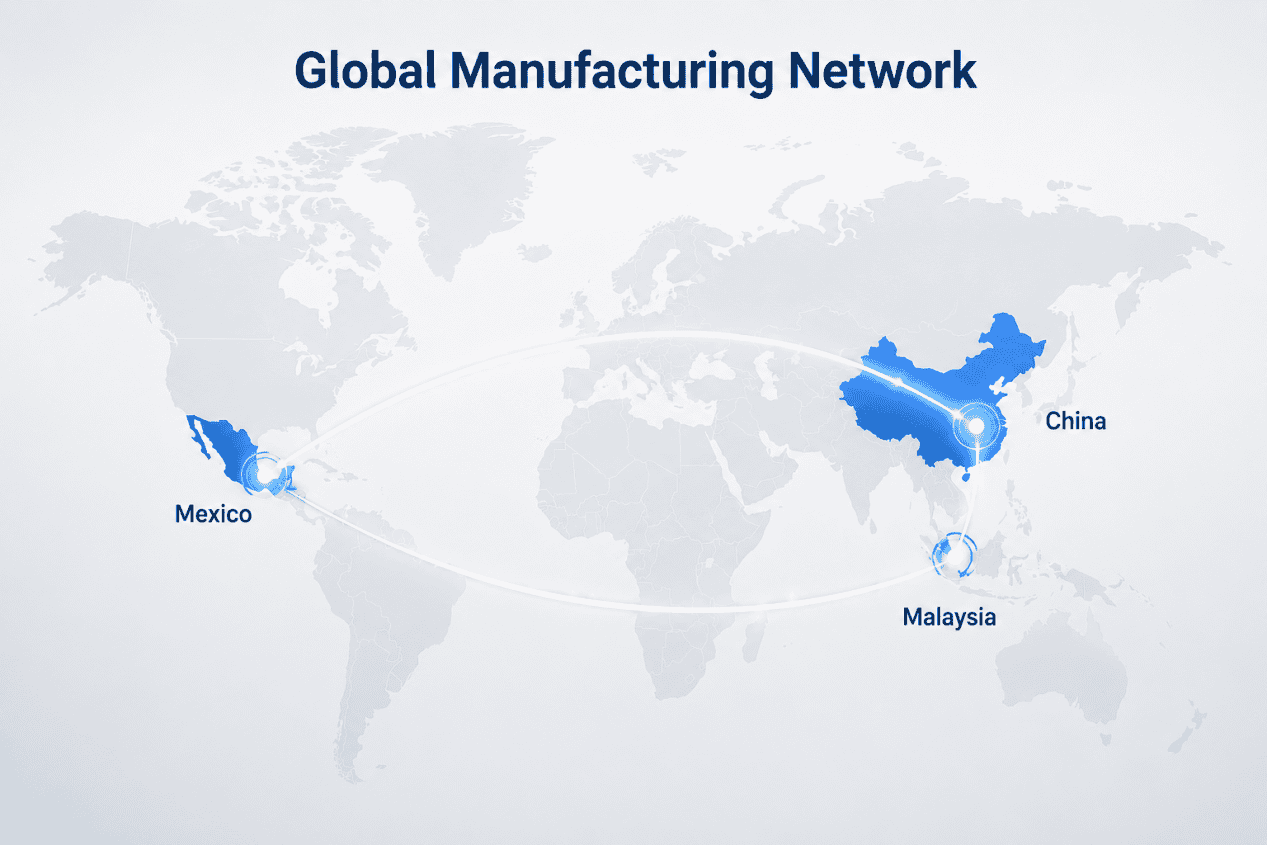 The objective is not to move every product between several factories. In many cases, one location remains the most practical choice throughout the project. The advantage is having alternatives when order volumes, component availability, delivery requirements or target markets change.
PCBCool’s manufacturing locations are therefore not intended to be identical. Each one serves a different role within the wider production network.
China for PCB Capability, Sourcing and Scalable Production
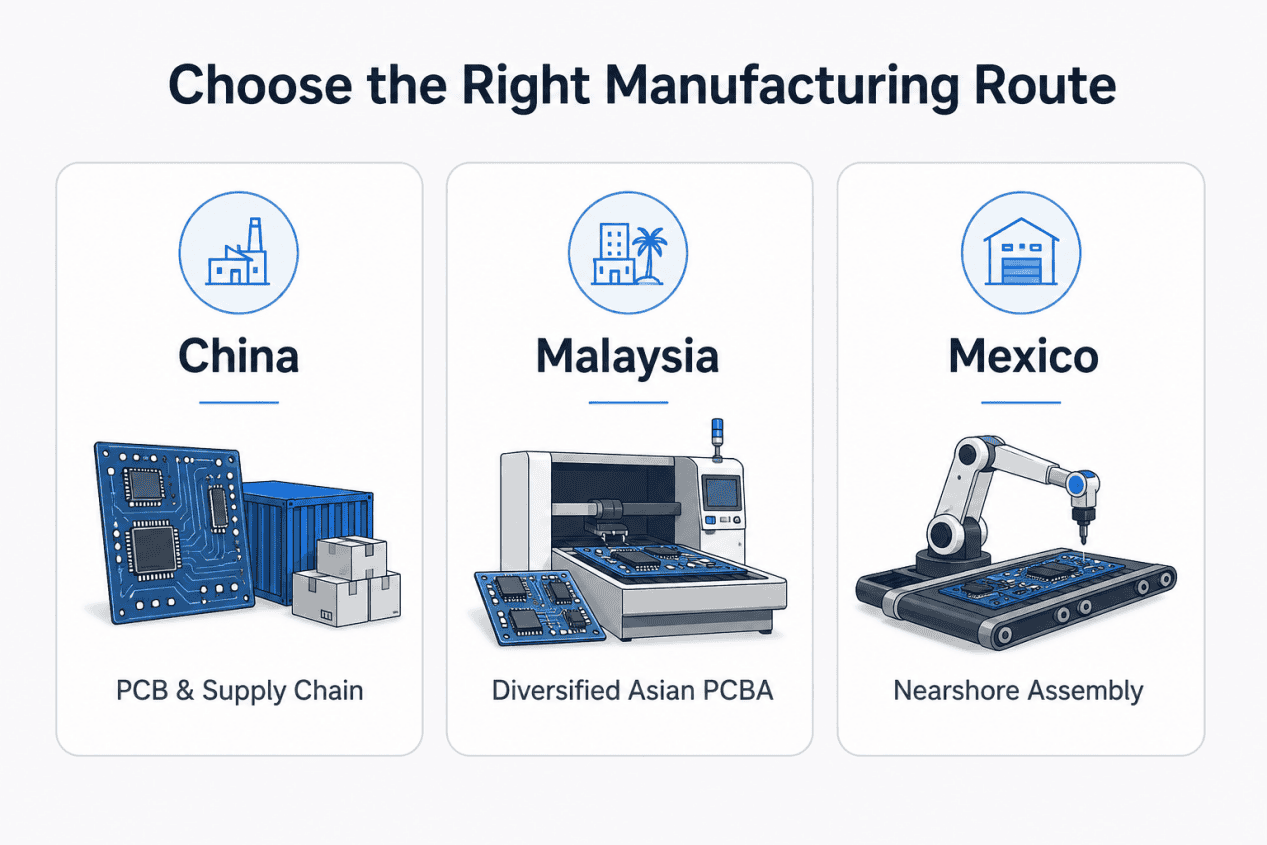
China remains the main manufacturing base for projects that require broad PCB fabrication capability, established electronics supply chains and production scalability.
The local ecosystem provides access to PCB materials, electronic components, assembly equipment and supporting processes within a concentrated manufacturing region. This is particularly useful when a project involves multilayer boards, controlled impedance, HDI structures, fine-pitch components or less common material requirements.
Component sourcing is another important part of this production route. The availability of distributors, manufacturers and supply-chain partners can simplify the procurement of semiconductors, connectors, sensors and electromechanical parts.
China is therefore suitable not only for cost-sensitive volume production, but also for technically demanding projects that depend on a wider range of PCB and component resources.
Malaysia as an Additional Asian PCBA Option
Malaysia provides another electronics assembly option within Asia.
For companies that do not want all production concentrated in one country, it can form part of a broader manufacturing diversification strategy. It may also be relevant when customers have regional supply-chain policies or internal sourcing requirements that call for an additional Asian production location.
The role of Malaysian manufacturers is not simply to duplicate the company’s China operations. Projects are evaluated according to assembly requirements, production volume, available capacity and the destination market before a location is selected.
This gives hardware companies another route for PCBA production without requiring them to build and manage an entirely separate supplier relationship.
Mexico for Nearshore Electronics Assembly
Mexico supports nearshore electronics assembly for products serving the North American market.
For some projects, the main advantage is geographic proximity. Compared with fully overseas assembly, production in Mexico can reduce transportation distance and create a shorter regional supply chain for products delivered to customers in the United States, Canada or Mexico.
This option may be especially relevant when a customer wants to keep PCB fabrication or component sourcing in Asia while completing part of the assembly or final integration closer to the destination market.
Nearshore production does not automatically replace Asian manufacturing. Its value depends on the product, order volume, material flow and final delivery requirements. The practical solution may involve one region or a coordinated combination of several.
Matching the Production Location to the Project
 A global manufacturing network only creates value when the production location is selected for a clear reason.
PCBCool evaluates factors such as board complexity, assembly process, component availability, order volume, target cost, destination market and expected delivery schedule before recommending a manufacturing route.
A project with demanding PCB fabrication requirements may be better suited to China. A company seeking an additional Asian assembly source may consider Malaysia. A product intended primarily for North American customers may benefit from assembly or integration in Mexico.
The location can also change as the product develops. Engineering prototypes may begin where technical resources and material availability are strongest. Later production can be adjusted when volumes increase or regional delivery becomes more important.
This approach gives hardware companies a manufacturing strategy rather than restricting them to a single factory.
One Connected Process from PCB Files to Finished Products
Multiple manufacturing locations are only useful when the project remains coordinated across them.
A fragmented supply chain can create new problems if PCB files, bills of materials, approved component alternatives and test requirements are managed separately. Information can be lost when the product moves from one supplier or region to another.
PCBCool supports projects within a connected manufacturing scope that can include PCB fabrication, component sourcing, SMT and through-hole assembly, firmware programming, inspection, testing, cable integration, enclosure assembly and final box build.
Customers can use a turnkey, partial-turnkey or consigned model.
Under a turnkey arrangement, the PCB, components, assembly and agreed testing requirements are managed together. Customers that already control part of their supply chain can provide selected components or materials while using PCBCool for the remaining production work.
This flexibility allows the manufacturing model to fit the project instead of forcing every customer into the same purchasing structure.
Keeping Engineering Knowledge Through Production
The transition from prototype to repeat production is often where manufacturing problems become visible.
A prototype batch may rely on temporary component substitutions, manual corrections or engineering decisions that have not yet been fully documented. These solutions may work for several boards but become difficult to control when production volumes increase.
Before manufacturing begins, PCB data, fabrication notes, stack-up requirements, bills of materials, placement files and test instructions need to be reviewed together. Conflicting dimensions, unavailable components or unclear assembly information should be resolved before materials enter production.
As the product moves forward, approved components, firmware versions, board revisions and test procedures must remain consistent across batches.
Keeping these records within one connected manufacturing system reduces the amount of information that must be rebuilt when production expands or moves to another region. Lessons from the prototype stage can be carried into pilot production and later manufacturing rather than being lost during a supplier transfer.
Component Sourcing Across a Global Supply Chain
Manufacturing capacity alone cannot keep a product in production if critical components are unavailable.
A completed PCB design may still be delayed by a microcontroller with a long lead time, a discontinued connector or a sensor approaching the end of its product lifecycle. These risks become more significant when companies manage procurement and assembly through unrelated suppliers.
PCBCool supports bill-of-material review, component procurement, availability checks and alternative-part evaluation alongside PCB assembly.
When a replacement component is proposed, its package, electrical specifications, temperature rating and lifecycle status need to be reviewed before approval. The objective is not simply to find a part that fits the footprint, but to confirm that it remains suitable for the product.
Coordinating component sourcing with manufacturing also allows the material schedule and assembly plan to be considered together.
Inspection and Testing Within the Manufacturing Process
Testing requirements vary widely between products.
A simple device may need standard inspection and a basic functional check. An industrial controller, medical product or energy system may require greater traceability and a test process designed around specific operating risks.
Depending on the project, production can include bare-board electrical testing, solder paste inspection, automated optical inspection, X-ray inspection, flying-probe testing, in-circuit testing, firmware verification and functional testing.
The purpose is not to apply every test method to every board. The test plan should be selected according to the failures that would matter most in the finished product.
This becomes especially important for hidden connections beneath BGA packages, components with polarity requirements and products that cannot be fully evaluated through visual inspection alone.
Global Manufacturing Is More Than a List of Factories
The strength of a global manufacturing network is not measured only by the number of locations it includes.
Hardware companies still need engineering communication, sourcing coordination, revision control, production visibility and a clear route from the initial files to the finished product. Without this coordination, several factories can create more complexity rather than less.
PCBCool’s manufacturing model connects these activities across its production resources in China, Malaysia and Mexico. The network allows projects to be placed according to their technical requirements, production stage and destination market while remaining within one broader manufacturing process.
A product may begin with prototypes in China, add production capacity in Malaysia or use Mexico for assembly closer to North American customers. Another project may remain in one location because that continues to provide the best balance of capability, cost and delivery.
The important point is that the manufacturing route can follow the needs of the product as those needs change. For global hardware teams, that flexibility can be as valuable as the production capability itself.